




Adelaide's Termite Control Specialists


With over 30 years of expertise in termite control, EcoPest Group is fully equipped to meet all your termite management needs. As a licensed and insured company, we provide comprehensive solutions designed to address current infestations while preventing future issues. We are committed to delivering results, backed by our guarantee. If we don’t fix the problem, it’s free.

SA Licensed and Insured Termite Inspectors
All our termite inspectors are fully trained in all aspects of termite inspections. EcoPest Group is a fully insured company.

We're Local
EcoPest Group is a 100% South Australian owned and operated Pest Control company, we employ locals with local termite species knowledge.

It's Fixed or it's Free
All our termite inspections are 100% guaranteed, if there’s termites on your property we won’t stop until we find them.
Understanding Australian Termites
Termites, often mistaken for white ants due to their similar appearance, are small soft-bodied insects native to Australia. With hundreds of species found across the country, these creatures play various roles in our ecosystem. While some species are important for recycling dead and decaying timber or feeding on grasses, others can cause significant economic damage to timber structures.
The economically significant species of subterranean termites pose a particular challenge. These termites traverse through soil, constantly foraging and assessing potential food sources. This behaviour makes them a serious threat to homes and buildings, as they can cause extensive damage before their presence is even detected.
The Significance of Termite Control
Termite attacks are common in Australia. Statistics suggest that one in three houses will experience a termite attack during their economic life. What’s more alarming is that most home insurance policies do not cover termite damage. This leaves homeowners to deal with the hefty repair costs, which can reach into the hundreds of thousands. Furthermore, a termite attack can significantly devalue your property.
Eco-Friendly Termite Management
We prioritise the safety of our clients and the environment. That’s why we use an eco-friendly and APVMA-approved termite management system. This approach ensures that our treatments are safe yet effective.
Expertise Across Australia
With experts in Adelaide, we’re well-positioned to provide termite inspections and control services across various locations. We also offer a range of other pest control services, including rodent control, possum control, spider control, and more. For professional assistance with termite control, reach out to EcoPest Group.
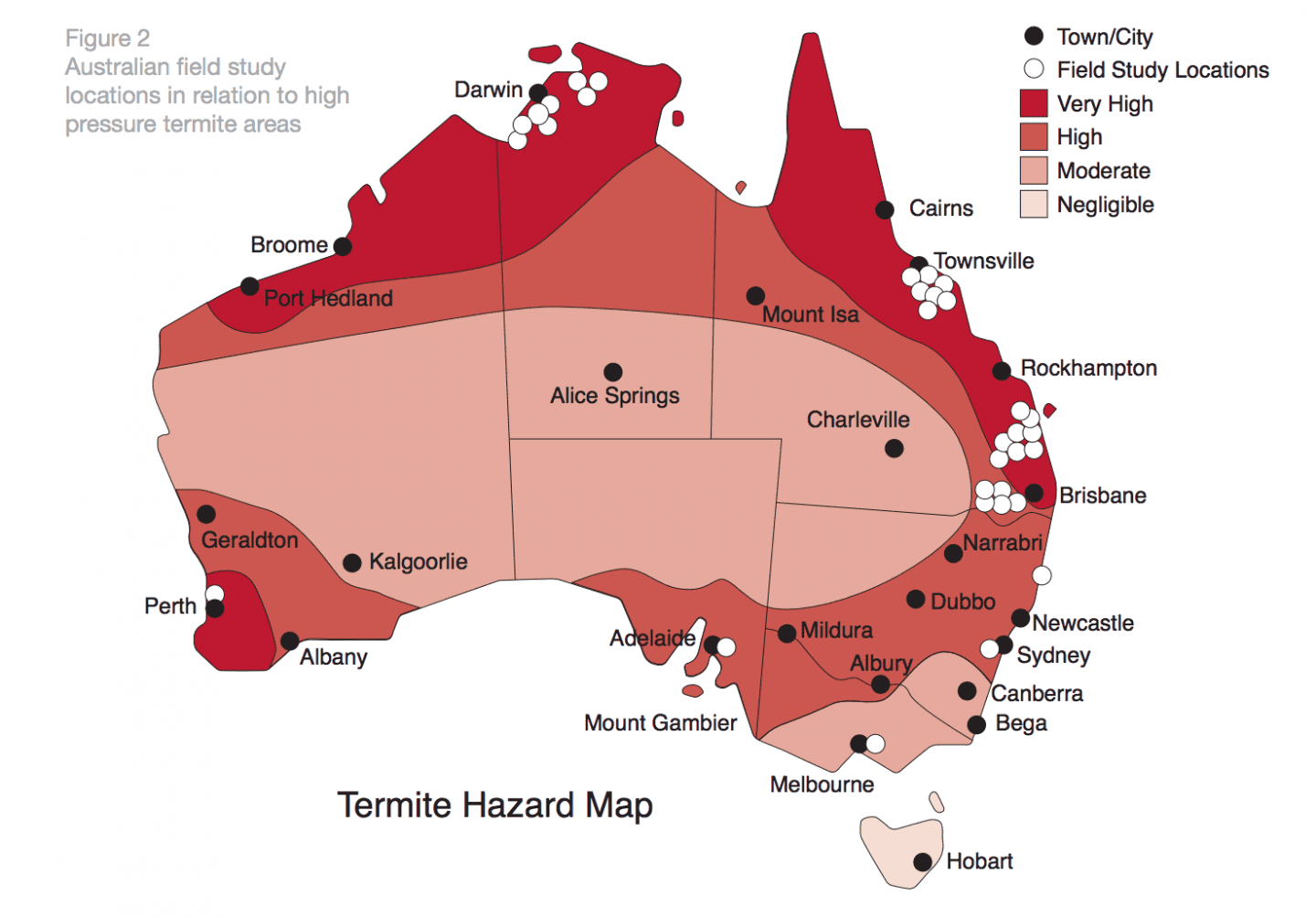
The termite hazard map below puts most homes and buildings at high risk of termite attack, therefore, termite control and inspections are essential on all properties.
Common Termite Species Found In Adelaide
Several destructive termite species are commonly found throughout metropolitan Adelaide and South Australia. Different termite species behave differently, which is why professional identification is important during termite inspections and termite management planning.
Coptotermes
Coptotermes are considered the most destructive termite species in Adelaide and are responsible for significant structural timber damage throughout South Australia. They commonly build concealed mud tunnels inside walls, roof voids, and subfloors, allowing colonies to remain undetected for long periods.
Heterotermes
Heterotermes are widespread throughout Adelaide and are commonly associated with timber in direct contact with soil. They are often found around fences, retaining walls, garden sleepers, and lower structural timbers. Although smaller than Coptotermes colonies, they can still cause considerable property damage if left untreated.
Schedorhinotermes
Schedorhinotermes are commonly found in damp environments, decaying timber, and moisture-affected areas. They are frequently detected in older Adelaide homes with leaking plumbing, poor ventilation, or subfloor moisture problems.
Nasutitermes
Nasutitermes are more commonly found in trees, stumps, fencing, and outdoor timber structures. While they are less destructive to homes than some other species, they may still spread into nearby buildings under favourable environmental conditions.
Common areas where termites are often detected include:
- subfloors and crawl spaces
- wall cavities
- roof voids
- fences and retaining walls
- timber landscaping
- gardens and tree stumps
- moisture-prone areas around buildings
Termite FAQs
Are white ants the same as termites?
Yes but technically no as termites are not related to ants.
- White ants’ is another name given to termites due to there ant-like appearance with a light colour or translucent body.
- Termites are also social insects like ants
- White ants (termites) are not the same as general ants and the treatment is very different
Can termites fly?
Yes, when the condition are right often on the first few warm humid nights of the year termite (alates) reproductives from from the nest to reproduce and set up new colonies, they are around 4-5 mm long mostly light brownish with wings.
Here a few tips and what it means and what to do.
- Flying termites are attracted to light so when you see them appear turn off external lights close to the house
- Signs of flying termites means there is a nest close by
- Flying termites will often fly from termite damage or workings within a structure
- Call 139 007 to arrange an expert termite inspection to determine the immediate threat level
Do ants keep termites away?
No, while termites are a great source of protein for ants, here are some reasons why ants do not keep termites from attacking your property.
- Termites colonies have their own soldiers to fight of ants
- Ants can not penetrate termite mud tubes
- Termites and ants are often know to co inhabit
Can a steel framed home get attacked by termites?
Yes, steel framed buildings are just as likely to get attacked by termites than timber framed buildings, they will still eat lots of timber joinery and other materials such as gyprock walls containing cellulose, however the damage bill is likely to be less, here’s how termites enter buildings built with steel framing.
- A 2 mm crack is big enough to allow termite entry into a steel framed building
- Termite can enter steel framed buildings via unprotected construction joins
- Breached slab edges are a known termite entry point into steel framed buildings
- Unprotected plumbing penetrations allow termite entry into steel framed buildings
- Various non visible construction faults are often the source of termite entry into steel framed buildings
What should I do if I find termites on my property?
If you find live termites or termite damage on your property.
- Put everything back as you found it and
- CALL OUR TERMITE RESPONSE TEAM IMMEDIATELY ON 139 007
- DO NOT disturb termites if found, too much disruption can push the termites into more concealed areas and delay our baiting and elimination process.
- DON’T spray them with ANYTHING such as fly spray or insect sprays, this also causes issues with treatment and elimination
What is the best way to control termites?
Our years of experience shows us that every situation is different, some factors that determine what method we will use are.
- The termite species found
- The extent of the termite damage
- The construction method of you home
- The termite pressure on your property
- Your budget
Is termite baiting better than spraying?
No one method is best in every situation, the factors that determine the best course of treatment are.
- Species termite present
- Amount of termite damage present
- The construction method and material of you home
- The amount of termite pressure on your property
- Your budget
Do termite stations attract termite to my home?
No, some facts on termite baiting and monitoring are.
- Termite stations will not attract termites to your property, the stations are designed to intercept foraging termites
- The baiting and monitoring systems will eliminate the colony which is the source of the problem
- Termite baiting and monitoring systems offer long term ongoing termite protection by eliminating termite colonies overtime
- Termite baiting stations act like an early warning system to let you you know termite are in the area
Can termites bypass the stations?
The failure rate of the EcoPest Group Termite baiting and monitoring system is VERY LOW. Here are some benefits of the EcoPest Group Termite Baiting and monitoring system
- The unique pre-baited termite stations emit CO2 and mimic decaying timber, which is a termite’s preferred food source. This greatly reduces the risk of termites missing the stations.
- Termites do not work in a straight line and are always on the lookout for food
- Unlike many systems, the EcoPest Group termite stations are pre-baited, ready to kill
- We use a range of active ingredients, dependent on the target species.
- The EcoPest Group stations are up to 80% more likely to intercept foraging termites than other termite baiting systems
Are concrete slab homes likely to get attack by termites?
The answer in most cases is yes, and here’s why
- Termites can enter through a crack around 2 mm
- Termite can enter via unprotected construction joins
- Breached slab edges are a known termite entry pint on concrete slab homes
- Unprotected plumbing penetrations allow termite entry
- Various non visible construction faults are often the source of termite entry on concrete slab homes